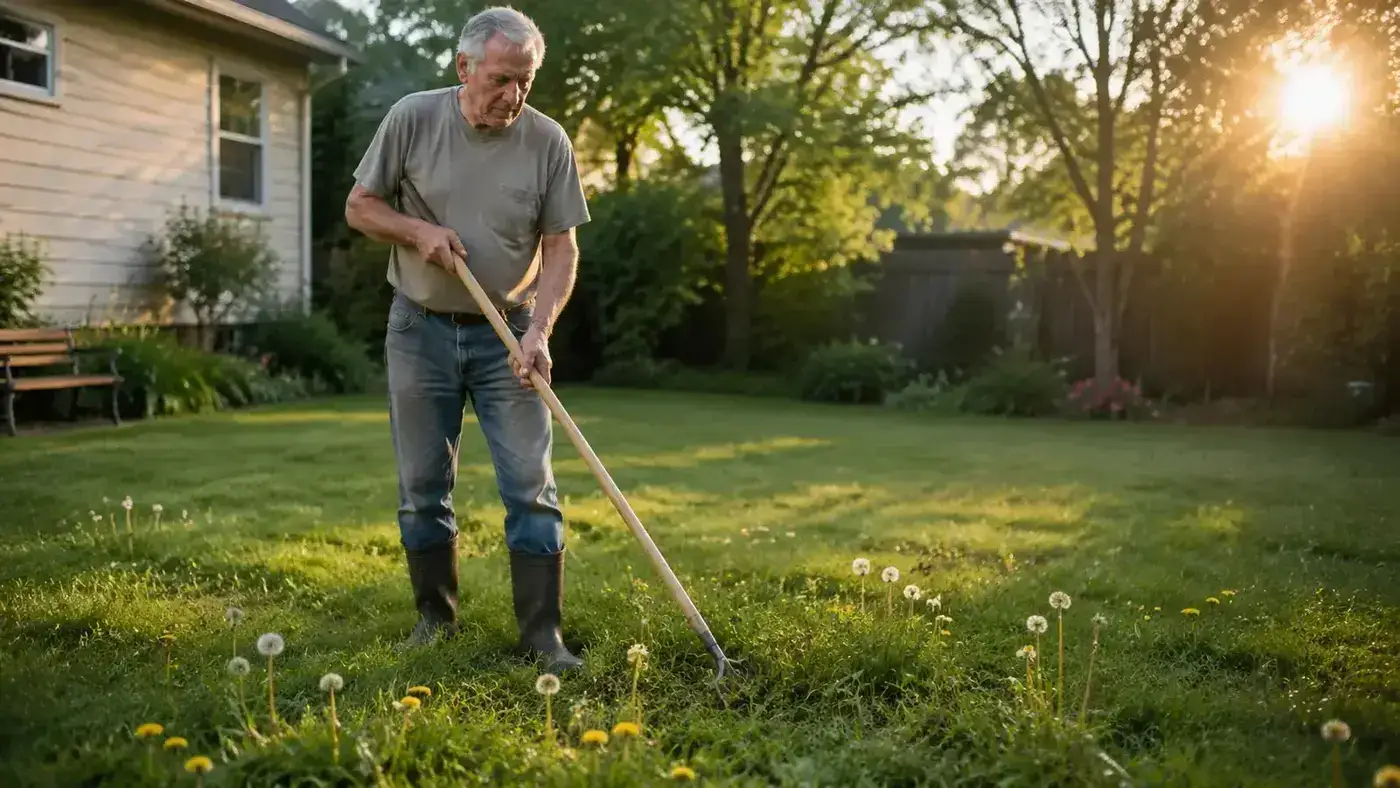
Three years ago my back gave me a choice: either stop weeding the lawn on my hands and knees, or spend the next week paying for it. I had tried every workaround. A foam kneeling pad helped some. A garden stool helped a bit more. But the real problem was not the kneeling itself. It was getting back up. At 68, with two bad knees and a lower back that lets me know when I have pushed too far, the getting-up part was the whole problem. My neighbor Carol mentioned she had been using Grampa's Weeder for a couple of seasons and that I should try it. I figured a tool called Grampa's Weeder probably knew its audience. I bought one that same week. Three seasons and somewhere north of 400 dandelions later, here is everything I know about it.
The Quick Verdict
The best stand-up weeder for older gardeners who want to stay upright, pull the whole root, and keep their back out of the conversation entirely. Clay soil slows it down but does not stop it.
Amazon Check Today's Price →Your back has given you enough warnings. This is the tool that actually changes the math.
Grampa's Weeder is the original stand-up weed puller. No bending. No kneeling. Four steel claws grab the root and a foot pedal ejects it. Over 67,000 Amazon reviews and three years in my own yard say it earns the hype.
Amazon Check Today's Price on Amazon →How I Have Used It
My yard is roughly a third of an acre in central Ohio. The lawn is old and the soil is heavy clay, which means two things: weeds love it, and pulling them out is a project. I use Grampa's Weeder mostly for dandelions, broadleaf plantain, and the occasional patch of clover that gets too confident. I try to do a pass every two to three weeks through the spring and early summer when the weeds are actively growing. Each session runs about 30 to 45 minutes. That is far longer than I could manage kneeling.
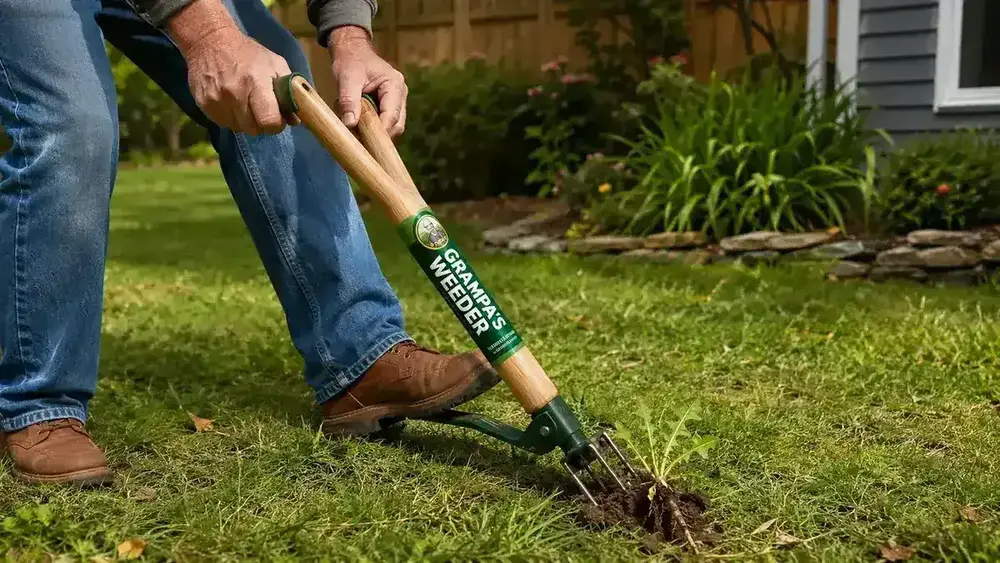
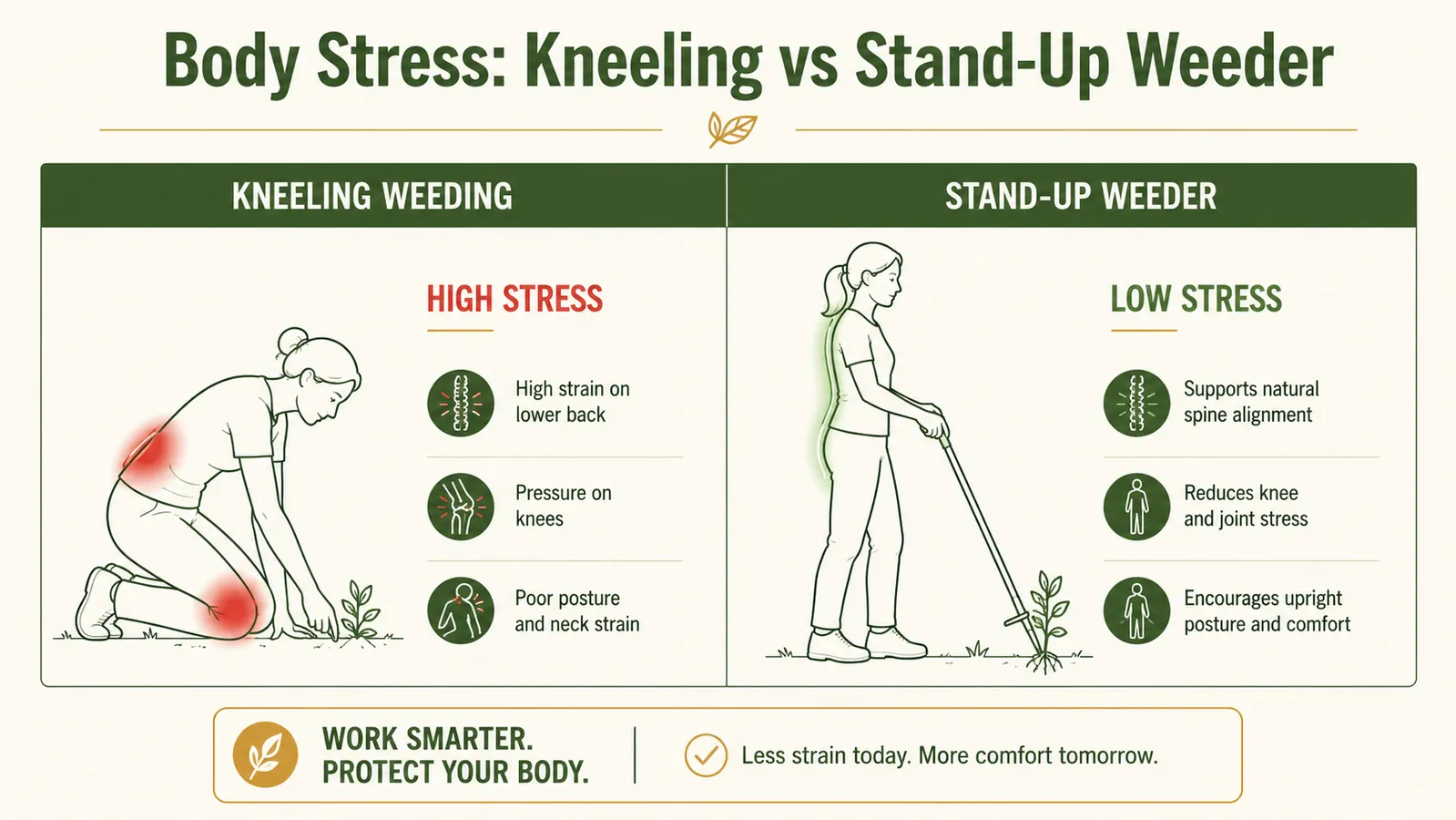
The routine is simple. I walk to a weed, center the four steel claws around it, press straight down into the soil with a little body weight, then rock the handle back to lever the root up. A second, smaller foot pedal near the base ejects the weed out of the claw head into a bucket or straight onto the ground. Then I move on. No bending forward. No kneeling down. No hands in the dirt. Standing fully upright the entire time. After 30 minutes of this, my back is fine. That was not the case with kneeling.
I have used this tool through three full growing seasons, through wet spring soil, dry July hardpack, and everything in between. The bamboo handle has developed a slight patina from sun and hand oils. The steel claw head shows normal surface wear. The mechanism still works the same way it did on day one. That kind of staying power from a garden tool at this price point is worth noting.
How the 4-Claw Design Actually Works
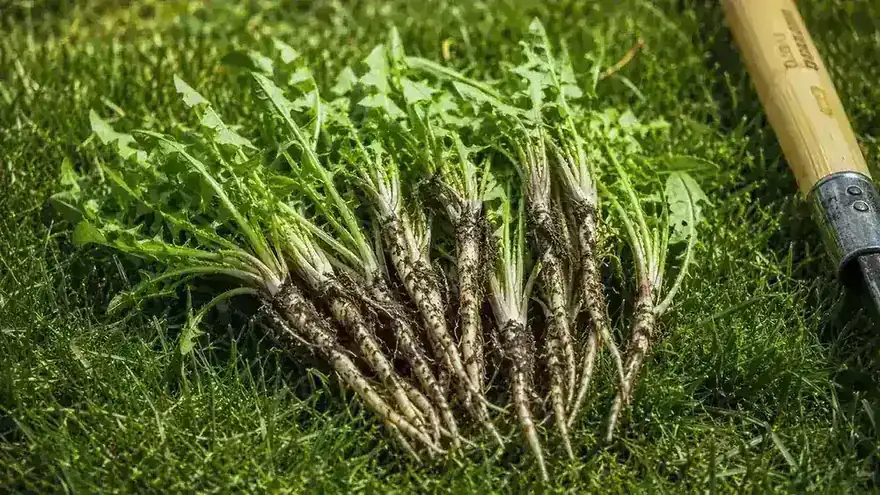
The claw head has four serrated steel tines arranged in a tight circle. When you push down, those tines drive into the soil around the weed stem and close inward slightly as they go deeper, gripping the root rather than just the top growth. The rocking lever action breaks the taproot loose from the surrounding compacted soil. For a dandelion, which can have a taproot 6 to 10 inches long in established lawn, that full lever stroke is what gets the whole thing out instead of just snapping the top off.
The ejection pedal is the part I was skeptical about before I tried it. It is a secondary foot trigger mounted partway up the handle, positioned so you can hit it without repositioning your grip. Step on it and a center rod drops down through the claw cluster, pushing the weed out cleanly. In practice it works exactly as advertised, and it means I am never bending down to clear a stuck root from the tines. That detail matters more than it sounds when you are doing this for 40 minutes.
Three seasons, 400-plus dandelions, and my back has never once been part of the conversation. That is the whole point of this tool, and it delivers.
Long-Term Performance: What Changes and What Does Not
After three years of regular use, here is an honest accounting of what has held up and what has changed. The steel claw head is essentially the same as new. There is surface rust on the tips from being left outside on one occasion, but it wipes off and has not affected function. The tines still close and grip correctly. The lever action has the same resistance as year one. Nothing has loosened, bent, or broken.
The bamboo handle is where I pay the most attention. Bamboo is real wood, and real wood responds to weather. In my climate, it has survived Ohio winters stored in an unheated garage with no visible cracking. The finish has worn smooth from hand contact, which actually feels better to grip now than it did when it was new. I have heard from other reviewers that leaving a bamboo-handled tool in direct sun and weather for months on end will eventually dry it out and lead to splits. I believe that. My practice is to store it inside the garage door once the season winds down, and that has been enough.
The one area where I have seen the tool slow down is in heavily compacted or rocky soil. When the ground is baked hard in August, the claws do not drive as deep, and a full root extraction sometimes takes two or three attempts instead of one. Watering the area 24 hours beforehand, or waiting until after a rain, makes a noticeable difference. That is a soil issue, not a product flaw, but it is worth knowing before you assume the tool will perform identically in every condition.
Dandelions vs Clover vs Crabgrass: Which Pulls Clean
Dandelions are where this tool is at its absolute best. The single deep taproot is exactly what the 4-claw design is built around. When the soil is reasonably moist, I pull complete dandelion roots probably 85 to 90 percent of the time. The other 10 to 15 percent I get most of the root but leave a stub, which in my experience means the dandelion comes back, though usually smaller. Still better than any kneeling approach I had tried before.
Broadleaf plantain also pulls clean. The fibrous tap-like root responds well to the lever action, and it is a satisfying pull when you get the whole thing. Clover is harder because clover spreads via runners and stolons, not a single deep root. The weeder grabs what is there, but it does not chase the spreading root system the way some people hope. I use it on clover to disrupt the plant and set it back, but I do not expect total eradication from one pull. Crabgrass is the hardest. It is a shallow-rooted grass that does not have the single taproot the design targets. The claws will grip it, but getting the root mass out cleanly is inconsistent. For crabgrass, my preferred approach is a liquid treatment, not this tool.
What a Bad Back and Bad Knees Actually Feel After Using This
I want to be direct about this because it is the reason most people in my situation are looking at this tool in the first place. I have two arthritic knees, a lower back that has had two epidural steroid injections over the past four years, and a shoulder that has never fully recovered from a 2021 rotator cuff repair. Kneeling to weed for 20 minutes used to mean two days of recovery. Standing to weed for 40 minutes with Grampa's Weeder means I might feel a little stiff in the morning, the same as any time I have been moderately active. That is a real and meaningful difference.
The tool does require some upper-body engagement to lever the handle back on deep roots, and on very resistant clay it takes a firm push to seat the claws. Neither of those has ever bothered my shoulder or wrists in a way that concerned me, but if you have very limited grip strength or a shoulder that cannot tolerate any downward pressure, you will want to try it on softer soil first and see how it feels. It is not effortless, but it is a fraction of the effort of kneeling work, and the key body parts it protects (knees, lower back, hip flexors) are exactly the parts that tend to give out as we get older.
What I Liked
- No bending or kneeling required at any point in the process
- 4-claw steel head consistently removes the full dandelion taproot when soil is moist
- Foot-pedal ejection means no hand contact with dirt or weed roots
- Bamboo handle holds up well with basic indoor storage between seasons
- Easy to use for 30 to 45 minutes without back or knee fatigue
- Simple mechanism with no moving parts to break or replace
- 67,000-plus Amazon reviews across years of real-world use
Where It Falls Short
- Performs significantly worse in hard, dry, or rocky soil
- Not well suited for clover runners, crabgrass, or shallow-rooted weeds
- Bamboo shaft needs indoor storage to prevent weathering and splitting over time
- Requires some downward push force that can fatigue weak grip or tender shoulders
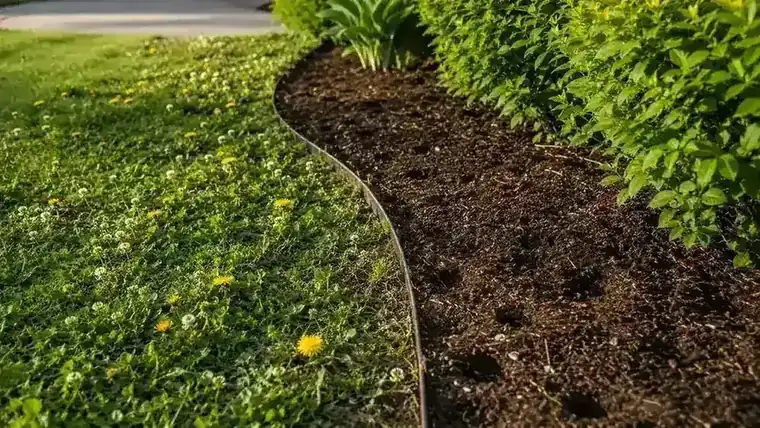
- Leaves small soil holes that can be cosmetically noticeable in a fine lawn
Who This Is For
Grampa's Weeder is exactly right for anyone who has a yard with a real dandelion problem, soil that is at least sometimes workable, and a body that has started registering objections to kneeling or bending for extended periods. If you are 50 or older and your lower back has started limiting your gardening sessions, this tool will extend those sessions by removing the single biggest cause of early quitting. If your knees have made kneeling painful or your doctor has told you to stay off them, this is one of the more practical adaptations I have found in the garden. It does not require strength or flexibility. It just requires standing up, which for most of us is still something we can manage.
Who Should Skip It
If your lawn is mostly crabgrass or creeping weeds, this is not the right primary tool. If your soil is hardpan clay that bakes solid all summer and you are not willing to pre-water before weeding sessions, you will be frustrated with the extraction rate. If you have a very small yard and only a handful of weeds a year, the value is there but the need is not urgent. And if you are dealing with weeds in tight raised beds or containers, the long handle makes positioning awkward in confined spaces. For those situations, a good hand weeder or a hori-hori gets into tighter angles. This tool is built for open lawn, and that is where it earns its reputation.
How It Compares to What I Tried Before
Before Grampa's Weeder, I used a standard long-handled cultivator to loosen weeds from standing, which worked for shallow-rooted stuff but rarely got dandelion taproots intact. I also tried a cordless electric weeder briefly, which was more vibration than I wanted to deal with and did not solve the root-extraction problem any better. The stand-up design with the claw head is genuinely different in how it mechanically grips and levers the root, and three years of use have not changed my opinion that it is the most effective hand tool I have found for this specific job. If you want a direct side-by-side comparison of this tool against the Fiskars stand-up model, I covered that separately in my Grampa's Weeder vs Fiskars comparison. The short version: they are closer than you would think, but there are real differences worth knowing before you choose.
I have also written about the body-mechanics case for stand-up weeding in more detail if you want the full argument. See 10 reasons a stand-up weeder is better for a bad back for the longer version. The summary is that eliminating the kneeling-and-rising cycle is the single most important thing an older gardener can do to extend their weeding sessions without pain, and this tool makes that practical for most people who have open lawn and real taproot weeds.
Three seasons in. Same tool. No regrets. Check the current price and see what other real users are saying.
Grampa's Weeder has over 67,000 Amazon reviews for a reason. If your back or knees have been limiting your time in the yard, this is a straightforward fix at a price that is easy to justify. Buy it, use it on the next rainy-day-plus-24-hours weed session, and see for yourself.
Amazon Check Today's Price on Amazon →