

I want to be straight with you right up front: the Makita DUB185Z is a bare tool. The 18V LXT battery and charger are sold separately. If you already own Makita 18V LXT batteries from another tool, you are set. If you don't, add a moderate amount to your budget for a starter battery and charger before you order. That changes the math, and you deserve to know it before you click anything.
With that said, I have been running this blower for two full fall seasons now. My name is Ray Halloran. I'm 67, I have a third of an acre in central Ohio, two big oaks and a maple that drop more leaves than any one person should have to deal with, and a left shoulder that has made me rethink every overhead and pull-start motion in my tool shed. The DUB185Z was the first battery-powered blower I gave a serious try after decades of gas. Here is the full report, honest and plainspoken.
The Quick Verdict
Light, quiet, pull-cord-free, and genuinely capable on dry leaves. The bare-tool price is fair if you have the battery ecosystem. Worth it for anyone who dreads the morning pull-start battle.
Amazon Check Today's Price →Already own Makita 18V LXT tools? This blower slots right in.
The DUB185Z uses the same battery platform as hundreds of Makita tools. If you have the battery, the bare-tool price is very competitive. Check today's price and confirm it is still in stock.
Amazon Check Today's Price on Amazon →How I Have Used It: Two Seasons in Real Backyard Conditions
I bought the DUB185Z in September 2024 after my old Husqvarna gas blower started giving me trouble on the pull cord. My left shoulder has some rotator cuff damage from an old fall, and every single time I yanked that cord more than twice I could feel it. Some mornings I'd yank it six or eight times in damp weather. That's when I started looking hard at cordless.
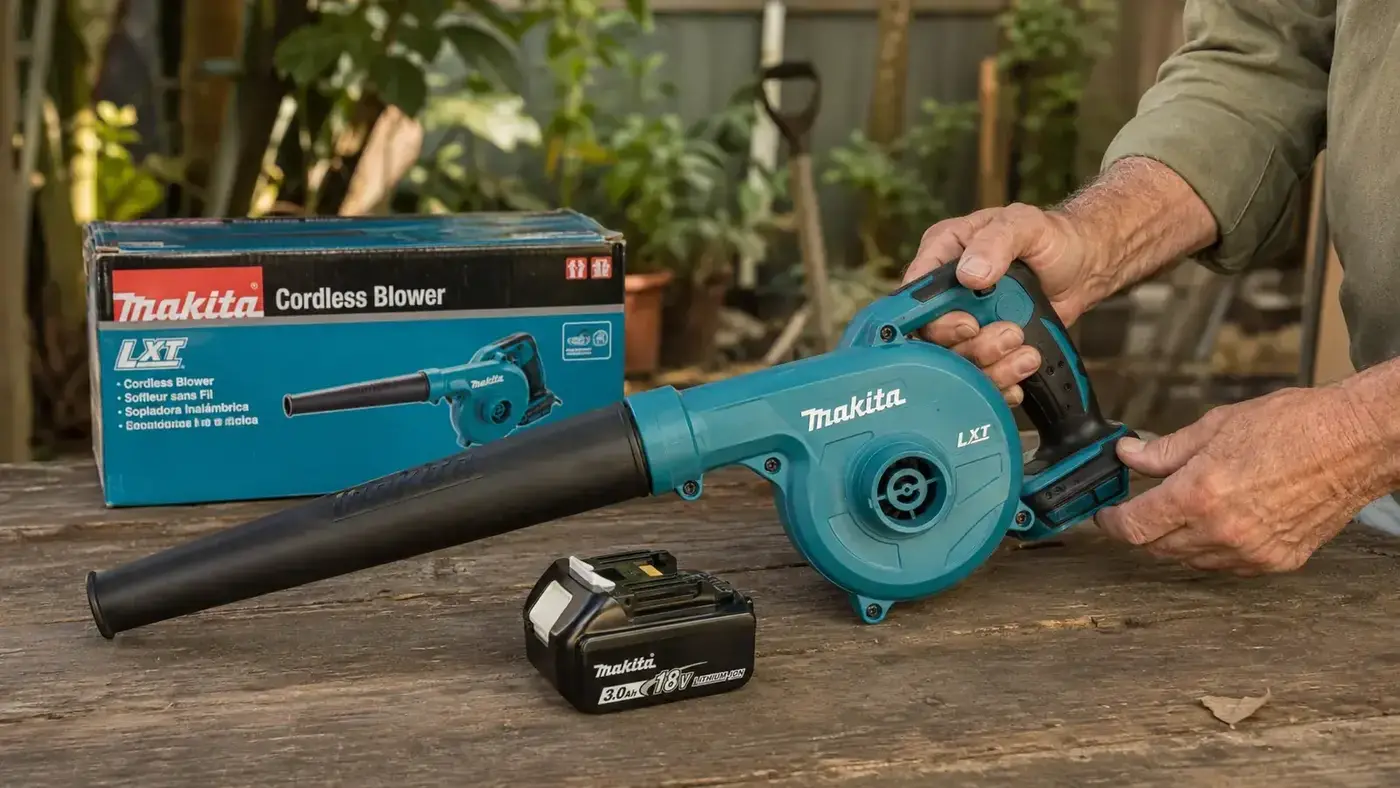
My wife already had a Makita 18V drill and impact driver set, so we had a couple of BL1840B 4.0Ah batteries and the DC18RC dual charger. That meant the bare-tool price was the whole cost for us. I ran the DUB185Z through all of October and November 2024, then again through the whole 2025 fall season. Different weather both years: 2024 was a dry, crisp fall. 2025 was wetter, with a solid two weeks of rain followed by a big October dump of damp leaves.
I also use it for lighter cleanup throughout the year: blowing grass clippings off the driveway after mowing, clearing the deck of cottonwood fuzz in spring, knocking dried mud off the garden path. So it gets used more than just six weeks a year in my hands.
What the Specs Actually Mean in Practice
Makita rates the DUB185Z at 91 MPH air speed with up to 200 CFM (cubic feet per minute) of airflow at high speed. On paper, a lot of budget cordless blowers claim higher CFM. I would encourage you not to put too much faith in raw spec comparisons between brands. What I can tell you is what I observed: the DUB185Z moves a solid windrow of dry leaves in one pass on high speed. On wet leaves, you have to work a little harder, but it still gets the job done if you keep the nozzle close to the ground and work from the edges inward.
The two-speed switch is on the top of the unit, easy to reach with your thumb. Low speed is genuinely useful for lighter debris like grass clippings or small flower petals near the beds where high speed would scatter mulch everywhere. High speed is what you use for leaves. Simple, and I appreciate that there are only two choices.
Weight is one of the biggest real-world factors for anyone with joint issues. The tool itself is 4.9 lbs without a battery. Add a 4.0Ah BL1840B and you are at about 6.4 lbs total. My old gas blower was over 11 lbs. That sounds like a modest difference until you carry it for 35 minutes. The Makita is something I can use one-handed for short stretches, which matters when I am clearing around the raised beds and need my other hand free.
Battery Life in Cold Weather: The Honest Numbers
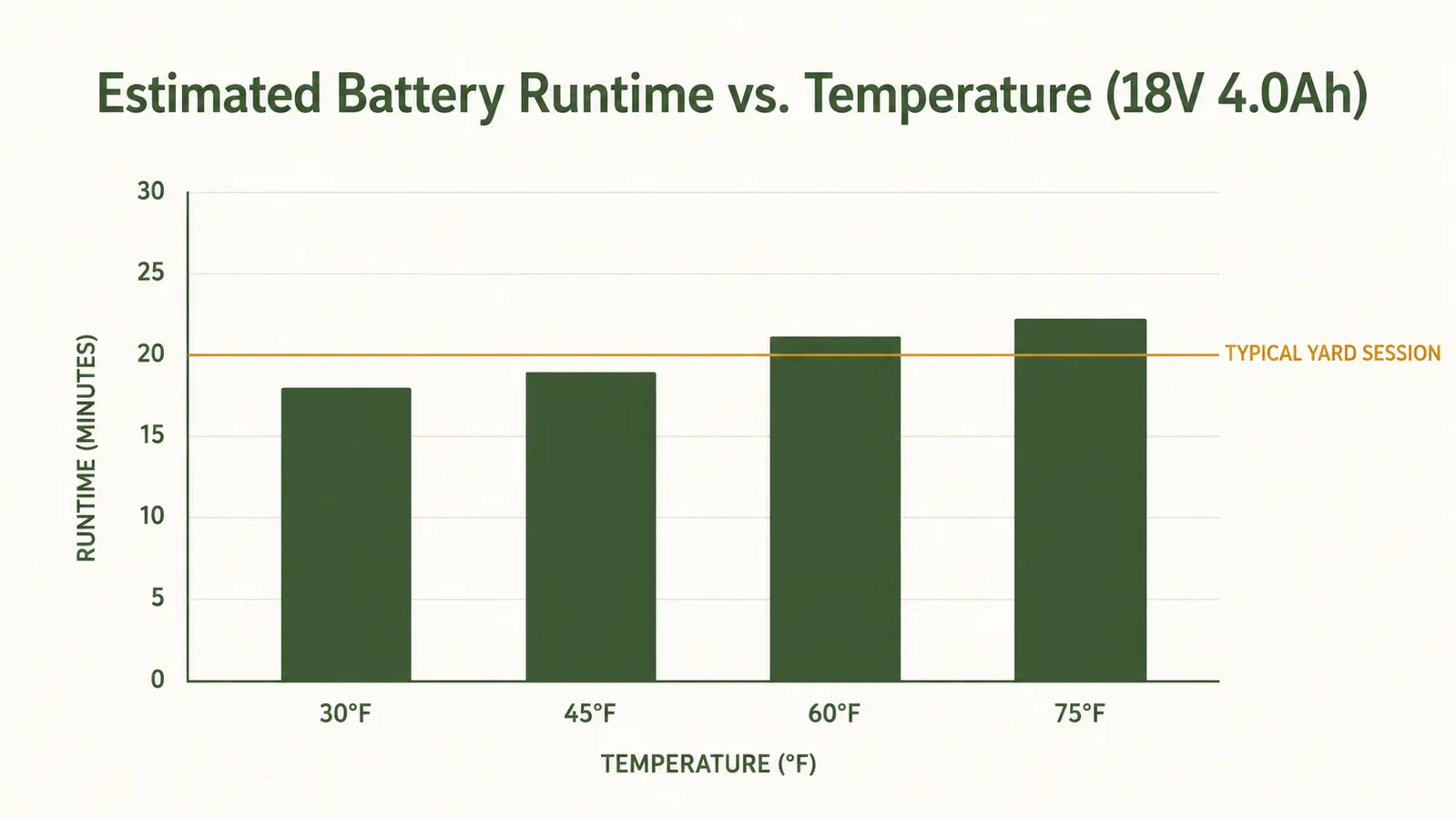
Cold weather cuts battery capacity, and if you garden in the northern half of the country you need to know this. On a 40-degree morning in November, running on high speed continuously, my 4.0Ah battery gave me about 18-20 minutes before the low-battery indicator lit. That was enough to clear the front yard and the driveway in one pass. If I needed the backyard too, I swapped the second battery and finished up. Runtime on a warm October afternoon on the same battery was closer to 25-27 minutes.
My advice: if you have a larger yard (half acre or more), plan on having two 4.0Ah batteries or one 5.0Ah battery in rotation. The charger tops off a 4.0Ah in about 45 minutes with the DC18RC, so you can charge one while using the other. If your yard is a quarter acre or less, a single 4.0Ah almost certainly gets you through in one charge.
I also keep my batteries inside the house on cold mornings and only bring them out to the garage when I'm ready to start. A fully charged battery that sat at 35 degrees overnight can start noticeably weaker. Warm batteries perform better. Small habit, real difference.
Yanking a cold pull cord eight times on a damp morning with a bad shoulder is not how I want to start a fall cleanup day. The Makita starts instantly. Every single time. That alone was worth the switch.
The No-Pull-Cord Benefit: It Sounds Small Until You Live It
I am going to spend a minute on this because it doesn't get enough credit in most reviews. With a cordless electric blower, you click the trigger and the motor spins up in about half a second. There is no choke, no prime bulb, no warm-up cycle, no flooding the engine if you pull too many times in a row. It starts on the first trigger pull at 60 degrees or at 28 degrees. It starts after sitting in the garage for six months with a charged battery.
For anyone with limited grip strength, sore hands, arthritis, or a bad shoulder, the pull cord on a gas tool is a genuine physical tax. Some mornings it isn't worth it. With the Makita, there is no barrier at all. You pick it up, you pull the trigger, you work. That is a real quality-of-life change, and I do not say that lightly.
The noise level is also meaningfully lower than gas. My neighbor, who has told me more than once that my old gas blower ruins his Saturday morning coffee on the patio, has not said a word since I switched. The DUB185Z is not silent, but it is at a level where normal conversation can happen nearby. That is not something you can say about any gas blower I have ever run.
Where It Struggles: The Honest Downsides
I said every review needs to have cons, and this one does. Wet leaves are the main test the DUB185Z doesn't ace. After a heavy rain, when the maple drops a full layer of wet mats on the grass, this blower moves them but you feel the work. You have to hold the nozzle very close to the ground, use short sweeping strokes, and accept that you will probably need to go over some patches twice. A gas backpack blower with more raw CFM would push those wet mats more aggressively. If you live somewhere that gets continuous fall rain and wet leaf drops are your normal situation, you might want a more powerful unit.
The nozzle length is on the shorter side, around 8 inches. If you are tall, or if your back doesn't like hunching forward, you may find yourself bending slightly more than you would with a longer nozzle. I compensated by keeping my elbow bent and working the blower lower rather than leaning over it. Not a deal-breaker for me, but worth noting if you are 6 foot 2 with a history of lower back trouble.
And again: the battery and charger are not included. This point deserves repeating because the Amazon listing leads with a price that looks very reasonable, and then you realize you are looking at a bare tool. If you are new to Makita's 18V LXT platform, budget for the combo starter kit as well. The DUB185Z is built for existing Makita LXT users who want to add a blower without buying into a second battery system.
What I Liked
- No pull cord: starts instantly, even on cold mornings, even with a sore shoulder
- Light at 4.9 lbs bare (about 6.4 lbs with a 4.0Ah battery): much easier to carry than gas
- Compatible with the 18V LXT platform: no new charger if you already own Makita tools
- Two-speed control is simple and thumb-accessible
- Much quieter than gas, far less disruptive to neighbors and your own hearing
- No gas, no oil mixing, no carburetor sitting gummed up over winter
- 4.5 stars from over 5,500 Amazon reviewers: broad real-world validation
Where It Falls Short
- Battery and charger sold separately: the actual startup cost is higher than the listed bare-tool price
- Wet, matted leaves require more passes and closer nozzle positioning than dry leaves
- Shorter nozzle may cause taller users to hunch slightly
- Battery runtime in cold weather (sub-45F) drops to around 18-20 minutes on high with a 4.0Ah

Alternatives I Considered Before Buying
Before I settled on the DUB185Z, I looked seriously at the EGO LB3804 and a couple of the Ryobi 18V handheld units. The EGO has more CFM on paper and its own 56V battery system is excellent. But the EGO handheld costs more and uses a different battery than everything else in a Ryobi or Makita shop. If you are starting from zero with no battery ecosystem, the EGO is worth a close look. If you already have Makita 18V tools, the DUB185Z slots in cleanly without buying another charger or another battery platform. That was the tie-breaker for me.
The Ryobi PCL570B is lighter and cheaper, and Ryobi's ONE+ platform is massive. I didn't go that route because my shop is already Makita, but I would not steer anyone away from Ryobi if they are already in that ecosystem. The principle is the same: stay in one battery family when you can. Charging two different kinds of batteries from two different chargers is an annoyance you don't need.
Who This Is For
The Makita DUB185Z is the right blower if you already own Makita 18V LXT batteries and want to stop fighting a gas blower. It is also the right choice if you have a bad shoulder, limited grip strength, or arthritis and you've been dreading leaf season because of the pull cord. The light weight, the instant trigger start, and the lower noise level are not marketing bullets. They are real daily differences. If your yard is a quarter to a third of an acre and your leaf load is typical, this blower will handle it well across a whole fall season.
Who Should Skip It
Skip the DUB185Z if you have a half acre or more with heavy, continuous wet-leaf drops and no existing Makita battery investment. In that situation, you would spend more (bare tool plus batteries you don't own) for a blower that may not fully satisfy you on your worst leaf days. Look at a more powerful cordless unit with a higher-capacity battery, or a corded electric if you don't mind being tethered. Also skip it if you already own a different 18V battery ecosystem like Ryobi ONE+ or DeWalt 20V. It is almost always smarter to buy a blower on the battery platform you already have than to start a second one.
Own the battery already? The DUB185Z is the easiest upgrade you can make to fall cleanup.
No gas, no pull cord, and light enough to use one-handed around the raised beds. Check today's price on Amazon and see if it's still available.
Amazon Check Today's Price on Amazon →