
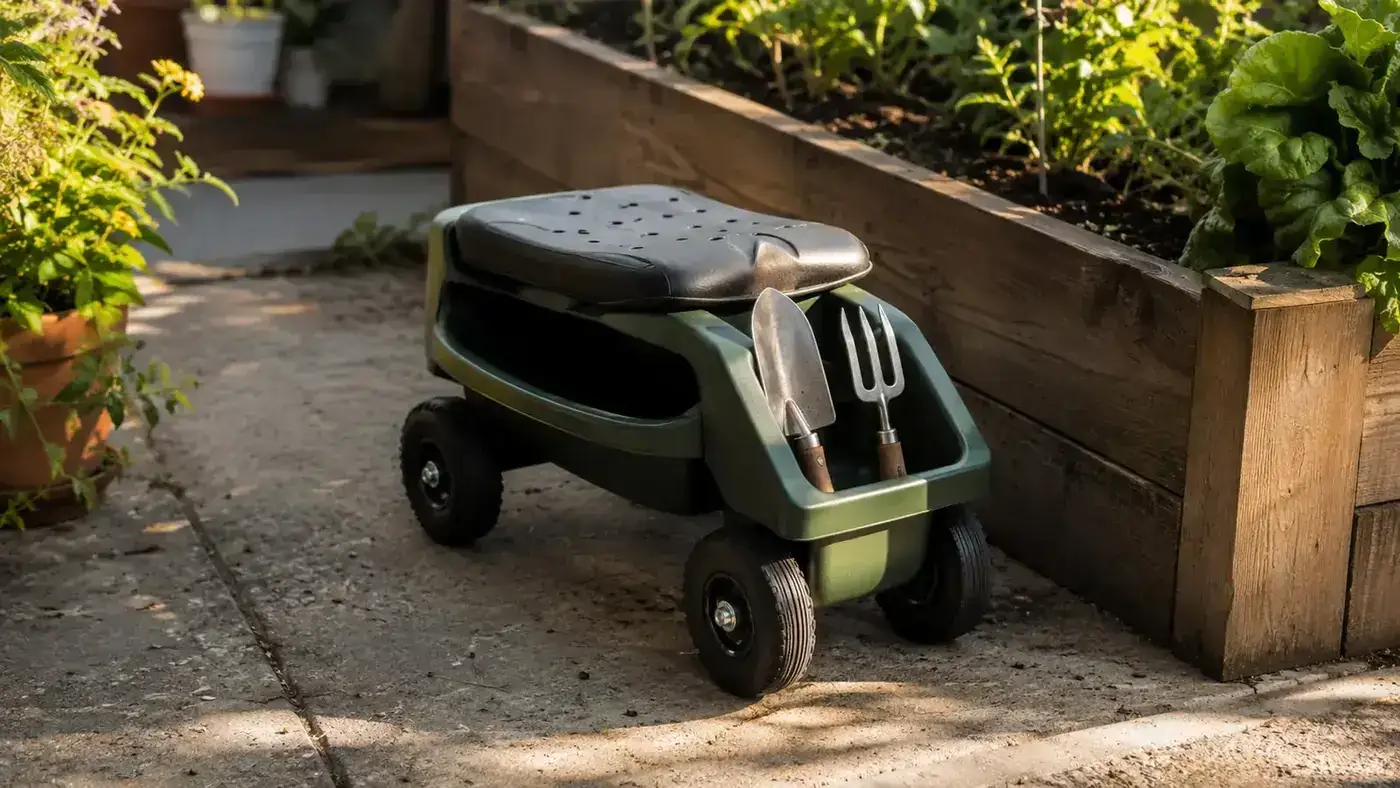
Here is a thing I noticed about the Amazon reviews for the Pure Garden Rolling Garden Seat: most of the five-star ones were written within two weeks of delivery. That is not an accusation. It is just worth knowing. Two weeks in, you have sat on it a handful of times in good weather, the plastic still looks new, and you have not yet asked it to roll across anything but a flat path. The picture looks rosier than it might in August, when you are trying to push it along a soft bed after a rainstorm and one wheel is sinking while you are trying to bend forward and pull a weed at the same time. I want to tell you what I know after using one through a real season, because the 4.1-star rating is sitting there for a reason, and nobody in the happy reviews seems to want to explain it.
I am not here to talk you out of buying this seat. For the right person, in the right garden setup, the Pure Garden rolling cart is genuinely useful and a fair deal for the current price. But there is a gap between what the listing photos suggest and what the seat actually does under daily conditions, and closing that gap before you order is worth three minutes of your time.
The Quick Verdict
Works well on firm, flat, dry surfaces. Struggles on soft soil, grass, and uneven ground. Plastic parts are adequate but not built for heavy users or hard knocks. Good value IF your garden terrain cooperates.
Amazon Check Today's Price →If your beds are flat and firm, this seat does exactly what it promises.
The Pure Garden Rolling Garden Seat is currently available on Amazon. Check today's price before deciding, because it often dips into budget territory.
Amazon Check Today's Price on Amazon →The Question Nobody Asks Before Buying: What Does Your Garden Actually Look Like?
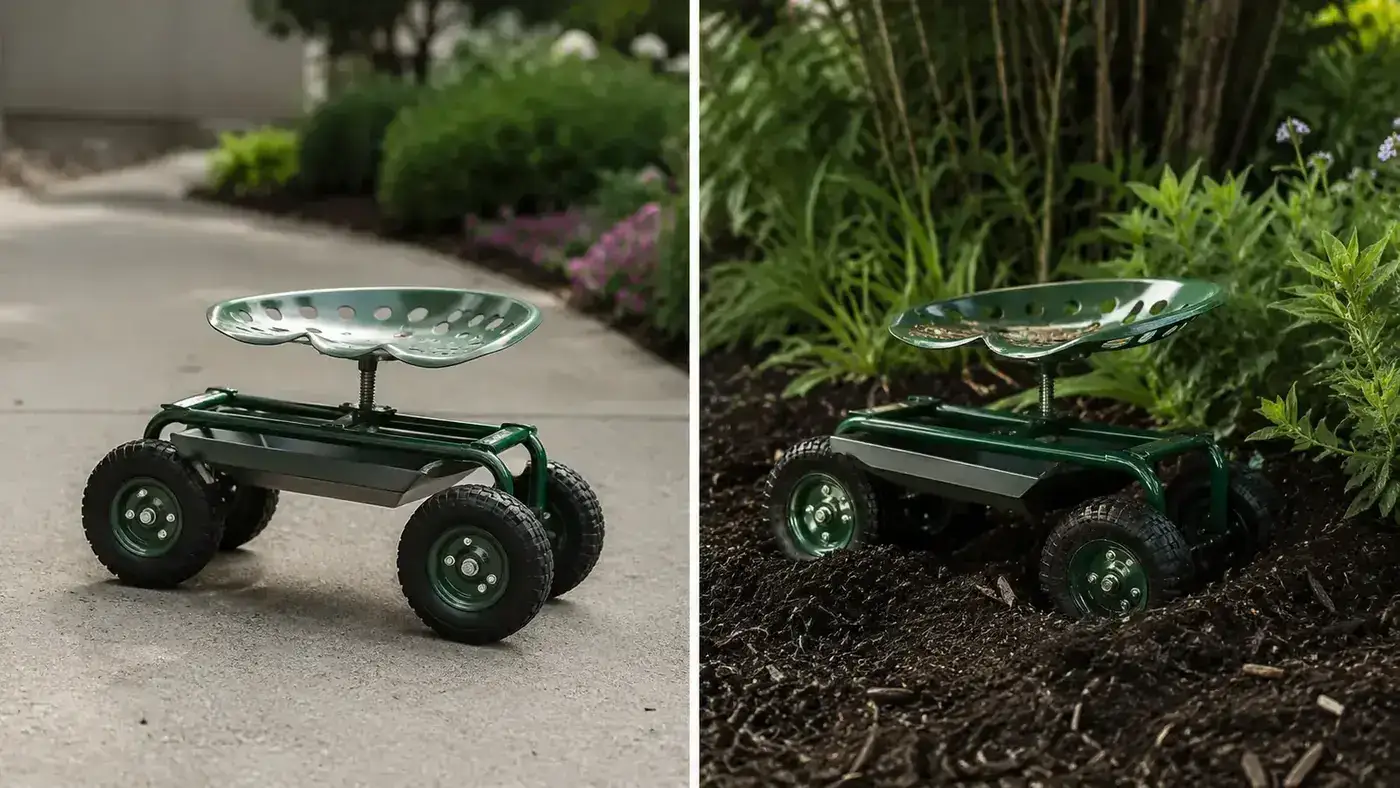
The rolling garden seat looks excellent in product photos because product photos are taken on concrete or smooth paving stones. The wheels spin freely, the seat scoots along without effort, and everything looks sensible. In a real garden, you have three or four distinct surfaces: the paved path between beds, the soil at the edge of a bed, the lawn between beds, and the mulched areas under shrubs. The seat handles exactly one of those surfaces without complaint, and that is the paved path.
On compacted bare soil, it works, but it takes noticeably more effort to push yourself along. On soft, recently worked soil, the wheels sink in about a half inch and rolling becomes actual work, defeating the purpose. On grass, you can move it, but the resistance is significant enough that most gardeners end up picking it up and setting it down rather than rolling it. If your garden is mostly lawn paths and raised beds on lawn, that gets old fast. On mulch, it sinks and tilts. That is not a design flaw exactly; it is just physics. Four small wheels on a soft surface will always behave this way.
The gardeners who get the most from this seat are the ones with concrete or paving-stone paths between their beds, or who use it primarily on a patio or driveway surface for container work. That is a real and common garden setup. But it is worth being clear-eyed about whether it describes your situation before you pay.
The Weight Limit Nobody Reads Until After They Order
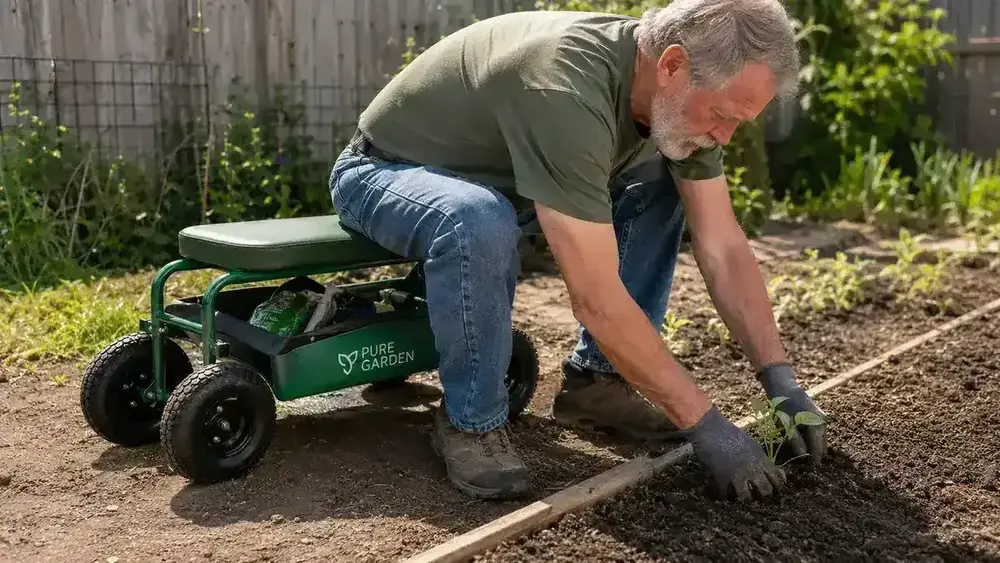
The listing says 250 pounds. That sounds like a comfortable margin for most people. What the listing does not explain is that the 250-pound limit applies to a person sitting still on level ground. Once you add the physics of leaning forward to plant or weed, you are adding leverage on a frame that is not made of steel. You are bearing down on the front edge of the seat with your lower body weight plus the torque of your torso extended in front of you. For a 200-plus-pound person working actively, the frame flex is noticeable. Not dangerous at normal body weights, but you can feel it, and you become aware that the plastic was not engineered with a lot of margin.
The negative reviews that mention cracking or breaking are disproportionately from users who are at or near the stated limit. I am not saying the limit is wrong. I am saying that if you are between 200 and 250 pounds, and you tend to lean hard when you work, you will likely stress this frame more than the engineers intended. If that describes you, a metal-frame garden scooter or a wood-reinforced kneeler bench is a better fit. The Pure Garden seat was designed for lighter loads on flat surfaces, and it performs well within those parameters.
What the Plastic Parts Actually Feel Like After a Season
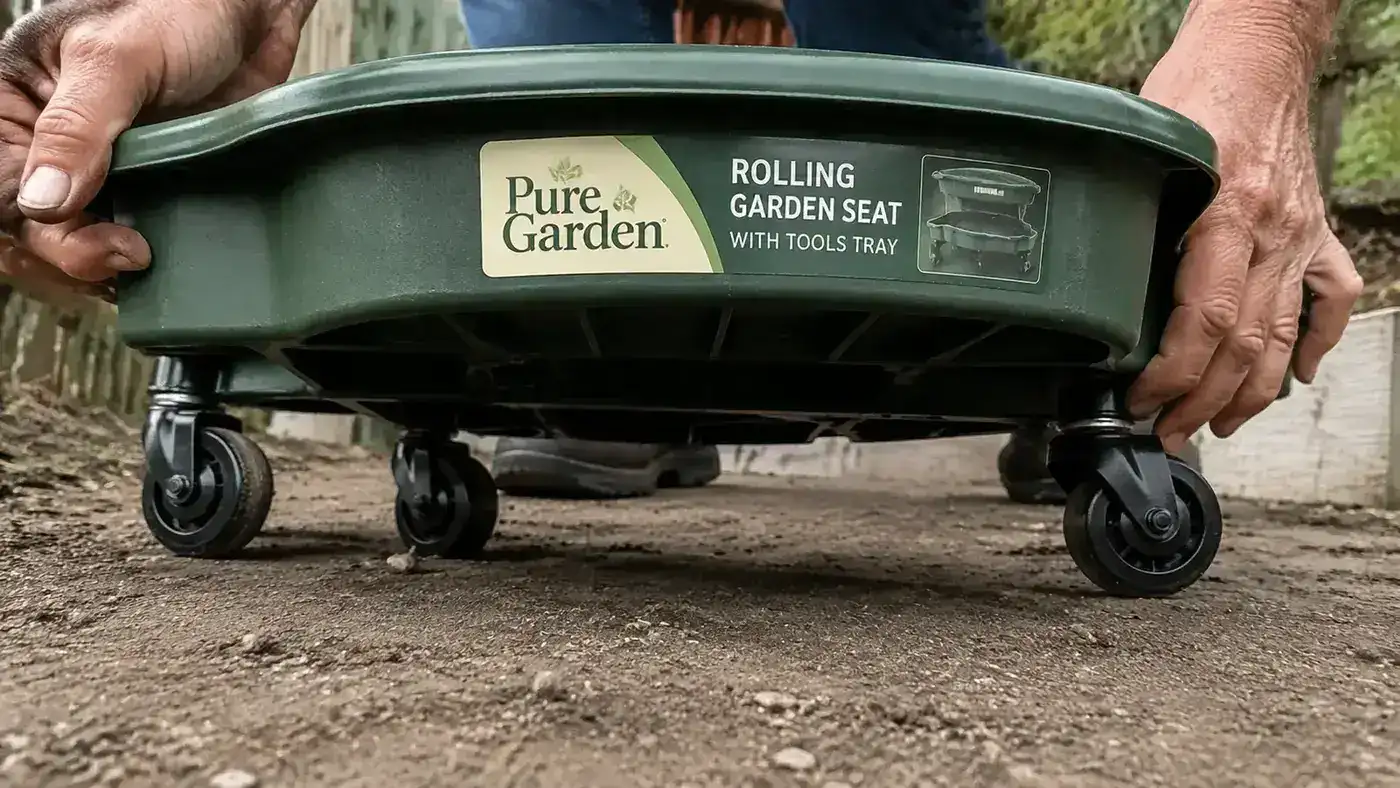
Everything on this seat is plastic except the wheels, which are a firmer plastic-and-rubber composite. The seat surface itself feels solid under you when you first sit down. The storage tray underneath is the part that ages least gracefully. After six months of trowels and hand forks being dropped in and out of it, the tray lid hinges on my unit had visible stress lines, and one hinge was loose enough that the lid would not stay fully open on its own. It still worked. It had not cracked through. But it was clearly showing its budget-tier materials.
The seat surface itself held up fine. No cracking, no flexing that got worse over time. The wheels did not wobble. The axle attachments stayed tight. My honest read on the plastic quality is that the structural parts are adequate and the accessory parts, meaning the lid and hinges on the storage compartment, are the weak points. If you are gentle with the lid and do not drop heavy tools in from height, it holds up better. If you treat it casually the way most people treat a garden tool, expect some cosmetic degradation on the hinges within a season.
The gardeners who keep this seat happy are the ones with concrete paths. If you are rolling across soft beds or lawn, you will be doing more carrying than rolling within a week.
What the Storage Tray Is Useful For and What It Is Not
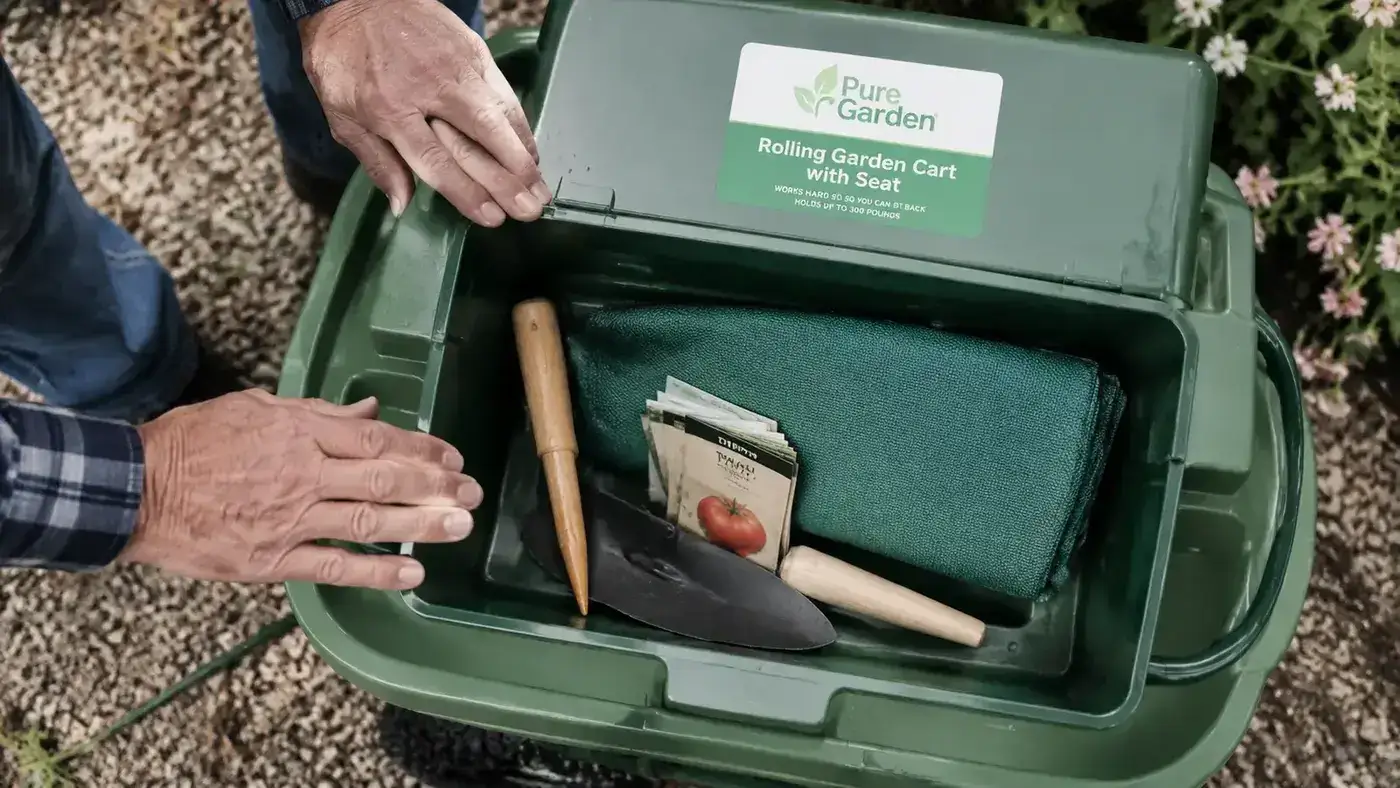
The storage compartment under the seat is genuinely useful for the right things. A hand trowel, a dibber, a small pair of bypass pruners, a packet of seeds, a pair of gloves: all of that fits comfortably and stays put when you roll from spot to spot. That is the main value proposition of having storage on a garden seat, and it delivers on it.
What the tray does not do well is hold bulkier items. A kneeler pad, a spray bottle, a full-size trowel with a long handle, or a bag of fertilizer do not fit in any useful way. The interior dimensions are more generous than they look in the photos, but they are still a compact space. Think of it as a dedicated pocket for the five small tools you need for one task, not a general garden caddy. Once I accepted that framing, I stopped being frustrated that my cultivator did not fit and started appreciating it for what it was: a way to bring the right hand tools along without making a second trip.
Assembly and Height: Two Small Things That Affect Daily Comfort
Assembly takes about fifteen minutes and does not require tools beyond what comes in the box. The instructions are clear enough. The one thing I wish I had known ahead of time is that the seat height is fixed. You cannot adjust it. It sits at roughly fourteen inches off the ground, which is comfortable for someone of average height to lower themselves onto and push up from. For someone taller than six feet or someone with limited knee bend, that is a low seat. For someone with a replaced hip, getting on and off a fourteen-inch seat with no armrests requires the same careful movement you would use getting in and out of a low lawn chair, which is to say you need to be deliberate about it. Not a dealbreaker, but worth knowing before you buy.
The rolling distance between sessions is better than I expected. Once you push yourself forward a foot or so, the wheels keep momentum on a flat surface. You are not fighting a heavy brake or a sticky wheel. The rolling action itself is fine. It is only the surface conditions that determine whether rolling is actually useful or just aspirational.
One thing that surprised me was how comfortable the seat felt after an hour. The surface is smooth hard plastic, which sounds miserable, but because the seat is low enough that you are resting your weight squarely on your sit bones rather than cantilevering forward, the pressure distribution is actually reasonable. I expected soreness after the first long session and did not get it. The trade-off is that there is no cushion and no back support. Lean forward to reach the far edge of a bed and all the support you have is your own core. If your back is the thing that limits your garden time rather than your knees, this seat may not solve your problem.
What I Liked
- Low price point makes the value-to-cost ratio genuinely good for lighter users on firm surfaces
- Storage tray is useful for carrying five or six hand tools from spot to spot
- Assembly is quick and the result feels stable on flat, firm ground
- Seat surface holds up well; structural plastic is more durable than the accessory plastic
- Reduces the need to get up and down repeatedly on a paved-path garden layout
Where It Falls Short
- Rolls poorly on grass, soft soil, and mulch; more useful as a low stool you carry than a seat you roll
- 250-pound weight limit has little margin for heavier users who lean forward while working
- Storage lid hinges show wear relatively quickly under normal use
- Fixed seat height at roughly 14 inches is low for taller gardeners or those with limited knee flex
- All-plastic construction will not last as long as a comparable metal-frame stool or scooter
Who This Is For
The Pure Garden rolling seat works best for someone who gardens on a relatively flat, firm surface, weighs under 185 pounds, and is doing the kind of work where staying low for fifteen to thirty minutes at a stretch is the main problem. Container gardening on a patio fits that description perfectly. A raised-bed garden with concrete or paving-stone paths between the beds fits it well. Row-crop vegetable gardening on level, dry soil fits it reasonably. If you have been doing that work by kneeling on a foam pad or sitting on a plastic bucket, this seat is a noticeable improvement at a price that makes sense.
It is also worth mentioning that this seat works as a general low stool for jobs that have nothing to do with planting. Painting the bottom trim on a fence, sorting through pots and tools in the garage, tending a fire pit, sitting low while a grandkid shows you something on the ground: all of those have nothing to do with rolling and everything to do with having a stable, low seat that you can carry one-handed. The storage tray does not hurt either. If you can get ten or fifteen uses a season out of it in a mix of sitting and light rolling contexts, the price is easy to justify.
Who Should Skip It
If your garden is mostly lawn, raised beds on lawn, or beds with soft working soil as the primary surface, this seat will frustrate you. You will spend more time picking it up and putting it down than actually rolling it, and a simple folding garden stool or a dedicated kneeler bench serves that situation better. If you are over 200 pounds and do most of your gardening leaning forward into deep beds, the frame will flex enough to make you notice it. And if you are someone who already has a metal-frame garden scooter with pneumatic tires, this is a step down from what you have, not a replacement worth considering.
The 4.1-star rating on Amazon reflects exactly this mismatch. A portion of buyers ordered it expecting it to roll across their lawn between plants the way it rolls across concrete in the photos, and when it sank into soft ground or dragged on grass, they were disappointed. The product is not broken. The expectation was just set by marketing images rather than real garden conditions. Read the one- and two-star reviews and you will see the pattern clearly. Nearly all of them describe a terrain mismatch, not a manufacturing defect.
Flat firm garden paths, under 185 pounds, tired of kneeling? This seat earns its keep.
The Pure Garden Rolling Garden Seat is a solid value for gardeners whose setup matches what it was designed for. Check today's price on Amazon to see if the deal is still there.
Amazon Check Today's Price on Amazon →