
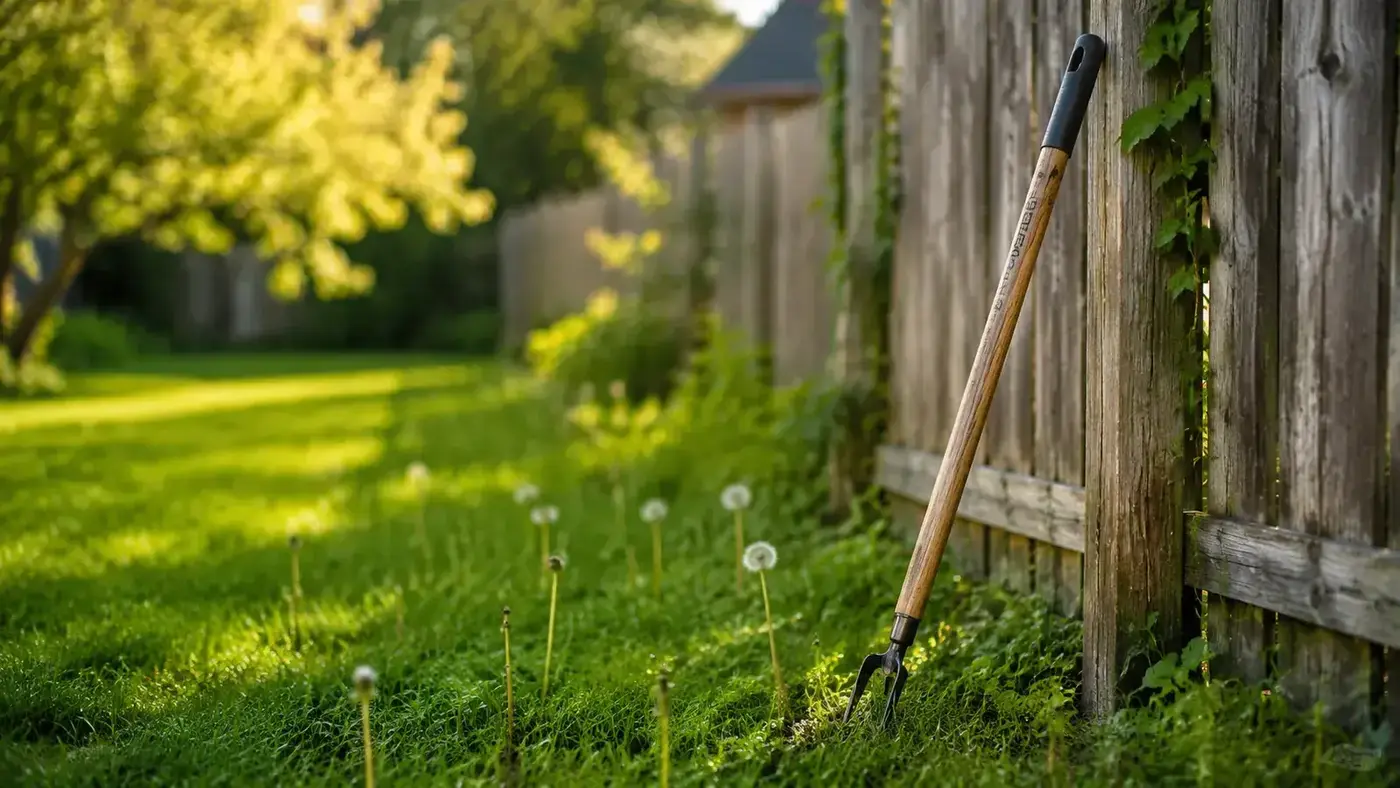
Every spring I walk out to my backyard and there they are. Yellow flowers, rosette leaves spread flat against the grass, and a taproot that goes halfway to China. I spent years kneeling down with a cheap weeding knife, grubbing around in the soil, getting maybe two-thirds of the root out, and standing back up with a lower back that reminded me exactly how old I was. Those dandelions came back every time. Because they always do when you leave even an inch of root in the ground.
The good news is that you do not have to kneel, crouch, or twist to do this properly. With the right technique and a decent stand-up weeder, you can remove dandelions root and all from a fully upright position. My back and knees are substantially happier for it, and my lawn has actually improved. This guide walks through every step I use, including a soil timing trick that most people skip and that makes the difference between a clean pull and a broken root.
Your back already hurts enough. The right tool pulls dandelions root-and-all from a standing position.
Grampa's Weeder has over 67,000 Amazon reviews and a four-claw design that grabs the taproot on the first push. It is the tool I reach for every spring morning.
Amazon Check Today's Price on Amazon →Why Dandelions Keep Coming Back (It Is All About the Root)
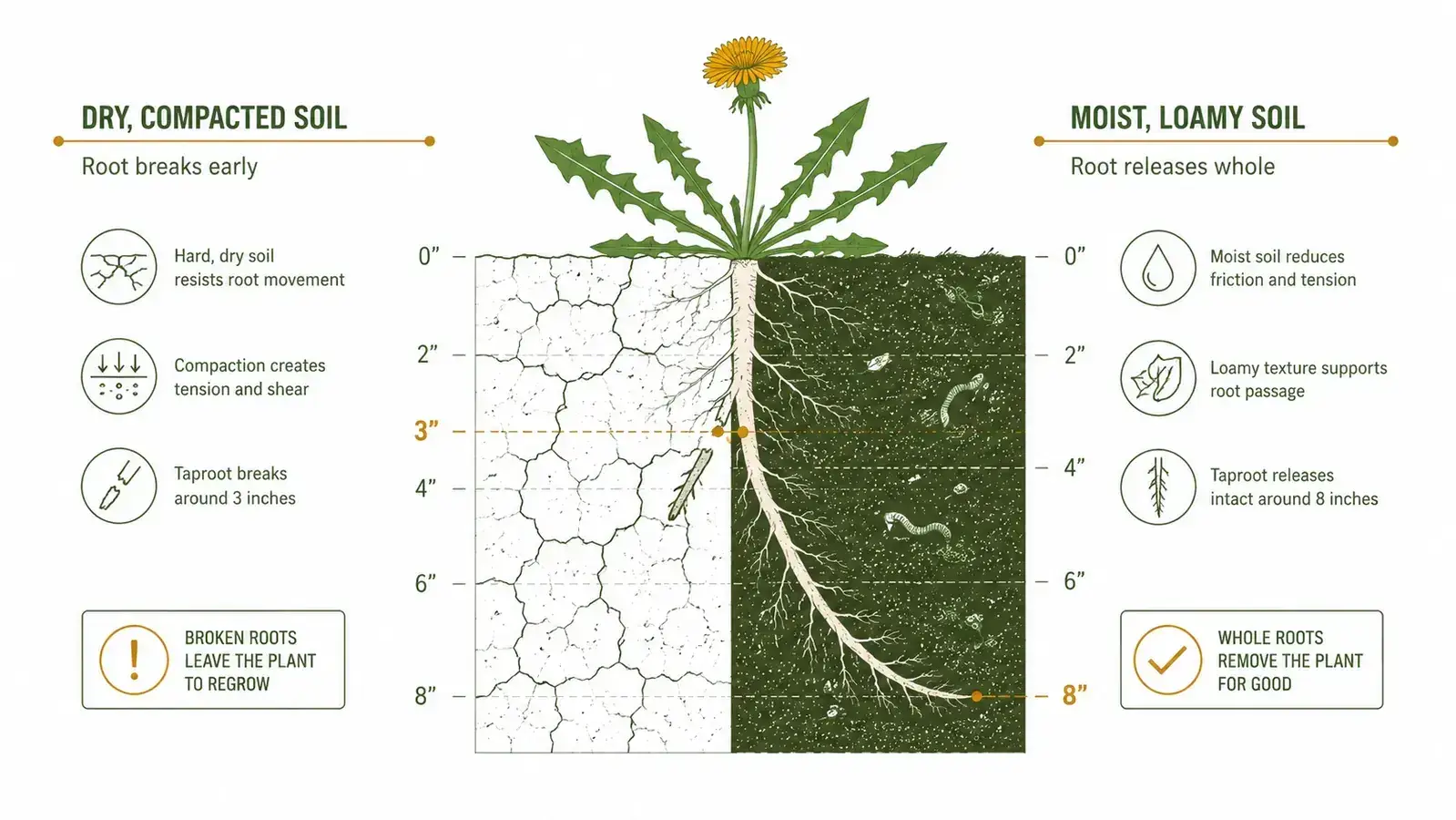
Before we get into steps, it helps to understand what you are actually dealing with. A dandelion taproot is a thick, fleshy, off-white root that can reach 6 to 18 inches deep in loose soil, though in compacted clay like mine it usually runs 4 to 8 inches. The plant stores energy in that root. If you pull the top off and leave even the top inch of root behind, the dandelion will regrow. It is not stubborn. It is just doing what a perennial weed does.
Hand tools that snap the root off at the crown give you a temporary fix. The plant looks gone for a week or two, then a new crown emerges from whatever root remains. True removal means extracting the whole taproot in one piece. That requires getting the claws of your tool deep enough, at the right angle, so the root releases rather than snaps. Soil moisture is the biggest factor in whether that happens.
Step 1: Time Your Pull for After a Rain (or Water First)
Soil moisture is the single most important variable in clean dandelion removal. Dry, hard soil grips the root so tightly that even a good stand-up weeder will snap it partway down rather than releasing the whole thing. Moist soil that has been watered 12 to 24 hours earlier, or that has received natural rain, is loose enough that the root slides free cleanly when you apply upward leverage.
If you have not had rain and your soil is hard, give the area a good soak the evening before you plan to weed. You do not need the lawn soggy. You need the top 6 to 8 inches to be workable. I run my sprinkler for about 20 minutes the night before a weeding session and the difference in root-pull success is dramatic. In dry clay soil I might get the root in one piece maybe 40 percent of the time. In moist soil that climbs to 80 or 85 percent.
One note: avoid weeding when the soil is truly waterlogged or sloppy. The tool sinks unevenly and you lose the mechanical advantage you need for a clean lever pull.
Step 2: Choose and Position Your Stand-Up Weeder
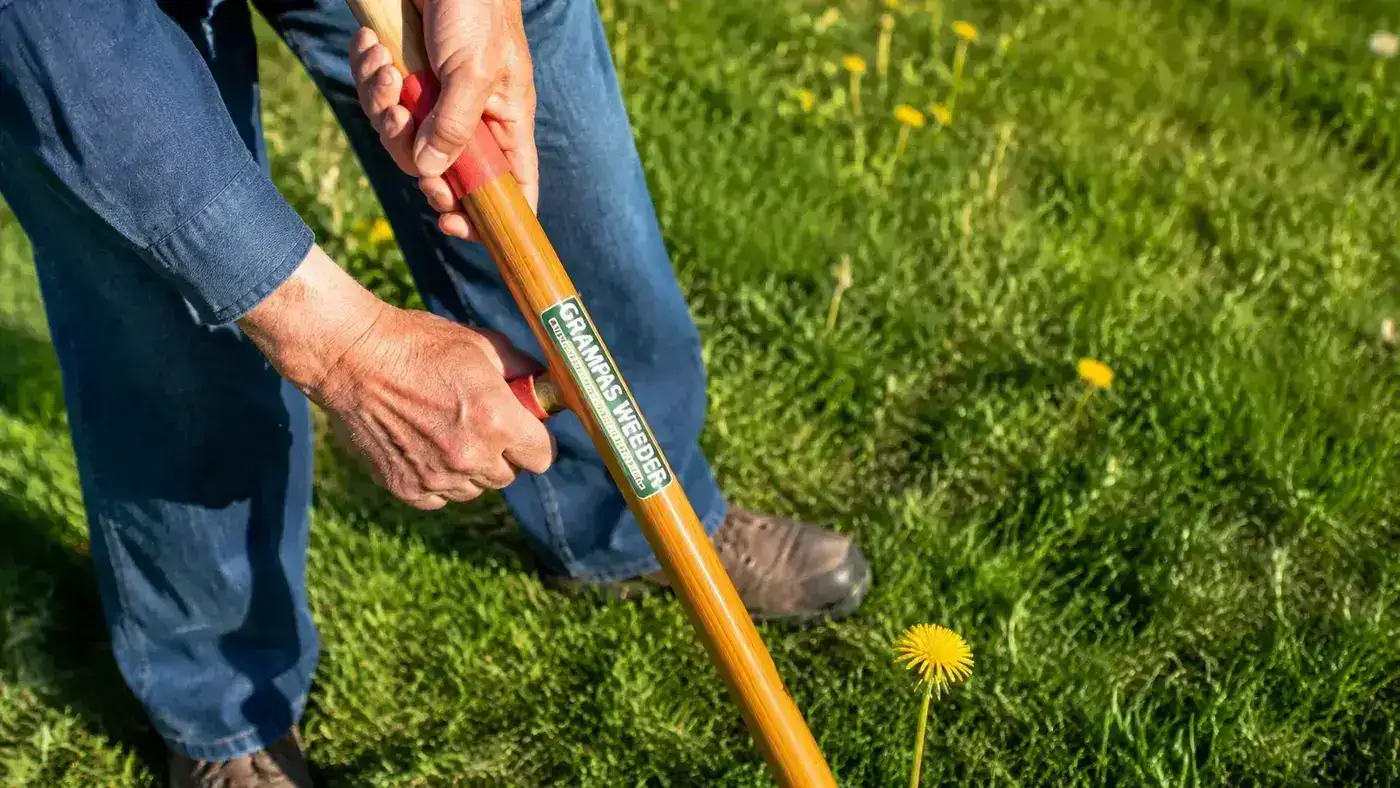
Not all stand-up weeders work equally well on dandelion taproots. The key feature is a multi-claw head that surrounds the plant's crown rather than cutting beside it. Grampa's Weeder uses a four-claw steel head that opens when you step on the foot bar, closes around the dandelion as you twist, and then releases the pulled weed when you press the eject pedal. That design gets the claws below the crown so you are levering the root out rather than tearing the top off.
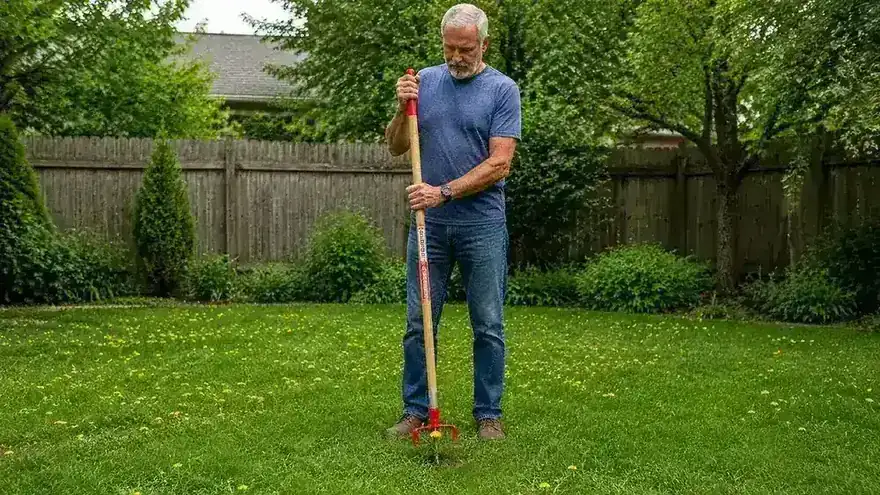
Position the tool directly over the dandelion so the center of the claw head lines up with the center of the plant's rosette. The claws should go into the soil surrounding the crown, not skewed to one side. If you enter at an angle you are more likely to snag and snap the root rather than ease it out. Take a moment to get the alignment right before you step down.
Step 3: Push the Claws In With Foot Pressure
With your tool centered over the dandelion, use the foot bar to push the claws straight down into the soil. Apply steady, even downward pressure with your foot rather than a sharp stomp. You want the claws to penetrate 3 to 4 inches down to get below the crown and ideally grip the upper section of the taproot. In softer soil after a rain this should take minimal effort. In harder soil you may need to rock the handle slightly side to side to work the claws deeper.
Listen for the claws to seat. You will feel a slight resistance change when they are past the crown and gripping the root mass. If your soil is very compacted and the claws are not sinking more than an inch or two, stop and water the area rather than forcing it. Forcing a claw head into bone-dry clay more often breaks the root than pulls it.
Step 4: Twist and Lever the Root Free
Once the claws are seated, use the handle to lever the root upward. On Grampa's Weeder, twist the handle slightly while pulling back. The twisting motion helps break the soil seal around the taproot so it slides up rather than snapping. Think of it less like pulling and more like unscrewing. A gentle combination of upward pull and rotation is more effective than a straight hard yank.
You will often feel the root release in one smooth motion when the conditions are right. When the soil is only moderately moist you may need to work the handle back and forth gently, like loosening a bolt that is a little stuck. Do not rush this step. A slow controlled lever pull extracts more root than a fast impatient tug. I have pulled dandelion roots 7 and 8 inches long out of my garden using this motion, which is deeply satisfying.
A slow controlled lever pull extracts more root than a fast impatient tug. The day I figured that out, my recurrence rate dropped by more than half.
Step 5: Eject the Weed Into a Bucket Without Bending
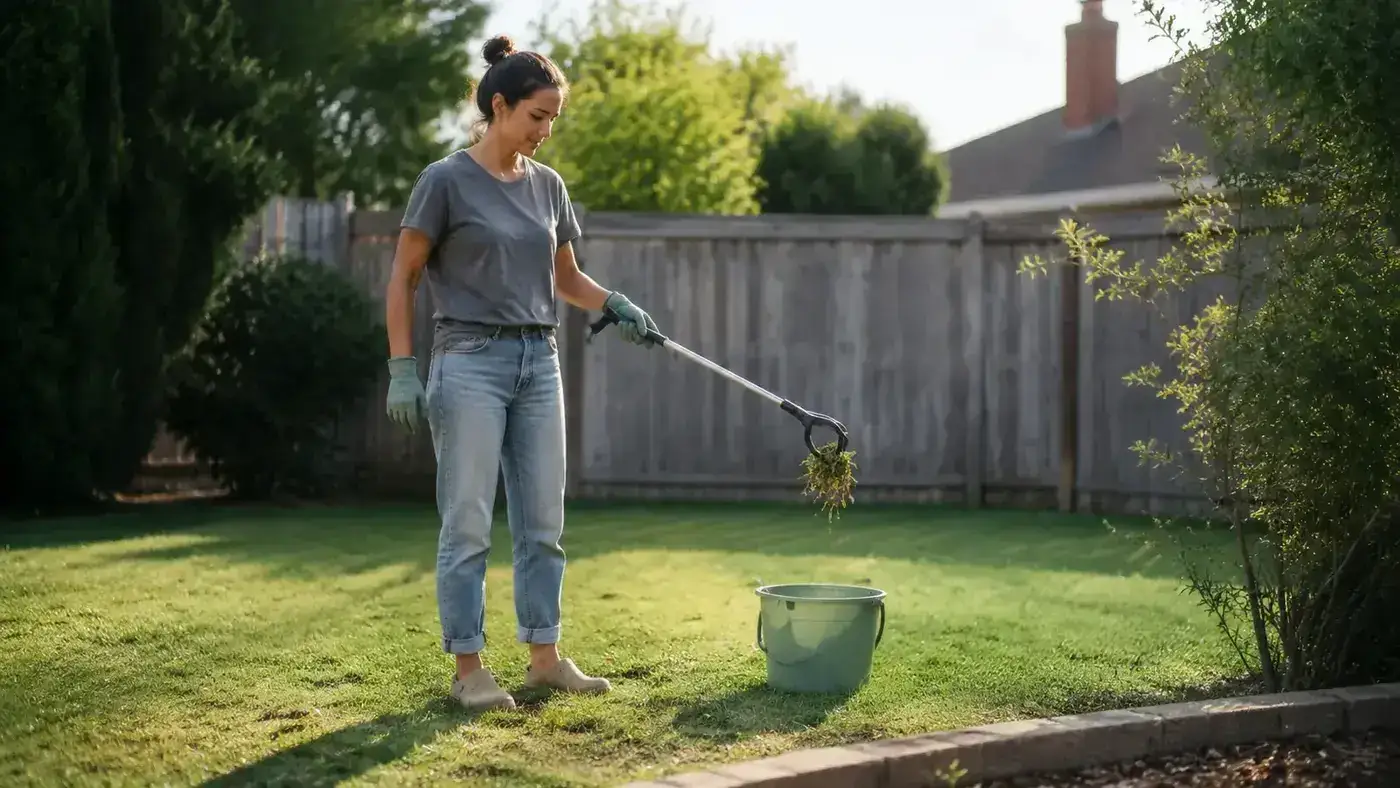
This is where most stand-up weeders fall short for older gardeners. You have pulled the root free, it is clenched in the claw head, and now you have to get rid of it. Some tools require you to kick or scrape the weed off the claws, which means bending down or squatting. Grampa's Weeder solves this with a foot-pedal ejection mechanism: you push the eject bar with your foot and the claws release, dropping the root. Hold the tool over a small bucket or trug bag and the weed lands inside without you stooping once.
I keep a 5-gallon plastic bucket on the lawn nearby and work my way across the yard section by section, ejecting into the bucket as I go. When the bucket is full I carry it to the compost or trash. The whole session is upright, steady, and on my schedule. My wife, who has the same bad-knee situation I do, took to this method immediately.
What to Do With the Holes Left Behind
A properly pulled dandelion leaves a small cylindrical hole where the taproot lived. This is a good sign, not a problem. The hole will naturally close within a week or two as soil settles, faster if you water. Some gardeners fill each hole with a pinch of grass seed before walking away. I do this in thin areas of my lawn and it works well. The removed root left a channel of loosened soil that new grass seed is happy to germinate in.
Do not compact or tamp the holes. Let them settle on their own. Tamping them down with your foot can actually damage the soil structure right where you want new grass to establish.
What Else Helps Keep Dandelions From Returning
Mechanical removal is the safest and most permanent solution for most home lawns, but a few additional habits help keep dandelion pressure low. Mow high, meaning keep your grass at 3 to 3.5 inches rather than scalping it short. Tall, dense turf shades the soil surface and prevents dandelion seeds from germinating. This alone reduces the number of new plants you have to pull each season. A thin, patchy lawn is practically an invitation for dandelions.
Overseed bare spots in the fall with a good turf grass appropriate for your region. Bare soil is where dandelions get their start. Fill those gaps with grass and you take away their opening. I overseed my lawn every October and by the following spring the dandelion count is noticeably lower in the areas that filled in well.
Corn gluten meal, applied in early spring before dandelion seeds germinate, acts as an organic pre-emergent. It will not kill existing plants, but it reduces new seedlings. It is not as effective as synthetic pre-emergents, but for those who want to avoid chemicals near kids or pets it is a reasonable option. Combine it with the mechanical removal method above and you get reasonable results without herbicides.
The Tool That Makes All of This Practical
I want to be straightforward about Grampa's Weeder because there are a few other stand-up weeders on the market and the differences matter. The Grampa's four-claw design grips the dandelion from four sides simultaneously, which gives you a more centered pull than two-claw tools. The bamboo handle is long enough that I can use it without any bend in my back at all, and at my height of about 5-foot-10, the handle length is right. Taller gardeners sometimes find the handle on the short side. The steel claws have held up to three full seasons in my clay-heavy soil without bending or spreading.
The foot pedal ejector is the feature I value most. It sounds like a small thing until you have pulled 40 dandelions and realize you have not bent over once to clear the tool. That adds up fast for anyone with a sore back or arthritic hands. Over 67,000 Amazon reviewers have weighed in on this tool, and the core consensus holds: it works as advertised when your soil is moist, and it saves your back. I agree with that assessment. The one area where it is less impressive is rocky or root-tangled ground, where the claws sometimes deflect rather than seat cleanly.
If you want the full breakdown of how the Grampa's Weeder holds up over multiple seasons, including the handle wear and how it performs in clay versus sandy loam, see my long-term review at the link below.
Pull the whole root. Stay on your feet. Your knees will thank you tomorrow morning.
Grampa's Weeder is the tool that made dandelion season manageable again. Four-claw steel head, bamboo handle, foot-pedal ejector. No bending required.
Amazon Check Today's Price on Amazon →