
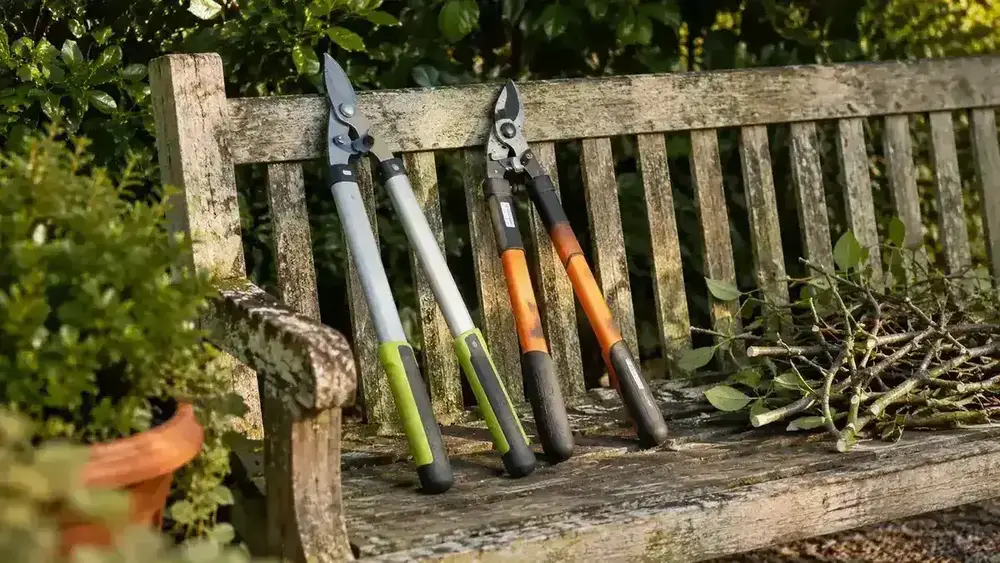
If you've spent any time looking for loppers that won't destroy your hands, you've probably landed on the same two names: the Spear & Jackson 8290RS ratchet anvil loppers and the Fiskars PowerGear. Both are well-reviewed. Both claim to multiply your cutting force. Both sit in a similar price range. So when my neighbor Frank showed up with the Fiskars after I'd been using the Spear & Jackson for a season and a half, we decided to settle it the right way: same hedge, same crape myrtle stumps, same afternoon.
The short answer is that both are real tools that do real work. But they do it differently, and for anyone dealing with reduced grip strength, arthritic hands, or a shoulder that has some history, the difference matters more than the spec sheet suggests. Here's what I found.
| Spear & Jackson Ratchet Loppers | Fiskars PowerGear | |
|---|---|---|
| Mechanism Type | 3-stage ratchet anvil | Gear-and-cam bypass |
| Max Cut Diameter | 2 inches | 1.75 inches |
| Handle Length | Telescopic, extends to 40.5 inches | Fixed at 32 inches |
| Weight | 2.4 lbs | 2.1 lbs |
| Blade Material | Hardened carbon steel, non-stick coated | Hardened steel, standard finish |
| Cutting Action | Anvil (blade closes onto flat bar) | Bypass (two blades pass each other) |
| Grip | Cushioned non-slip rubber, contoured | Plastic-capped, minimal padding |
| Amazon Rating | 4.6 stars (5,183 reviews) | 4.5 stars (approx. 3,400 reviews) |
If your hands are tired of fighting thick branches, the ratchet mechanism changes things.
The Spear & Jackson 8290RS is the reason I got through my entire crape myrtle row without stopping to rest my grip. Over 5,000 Amazon buyers agree it earns its keep.
Amazon Check Today's Price on Amazon →Where the Spear & Jackson Wins
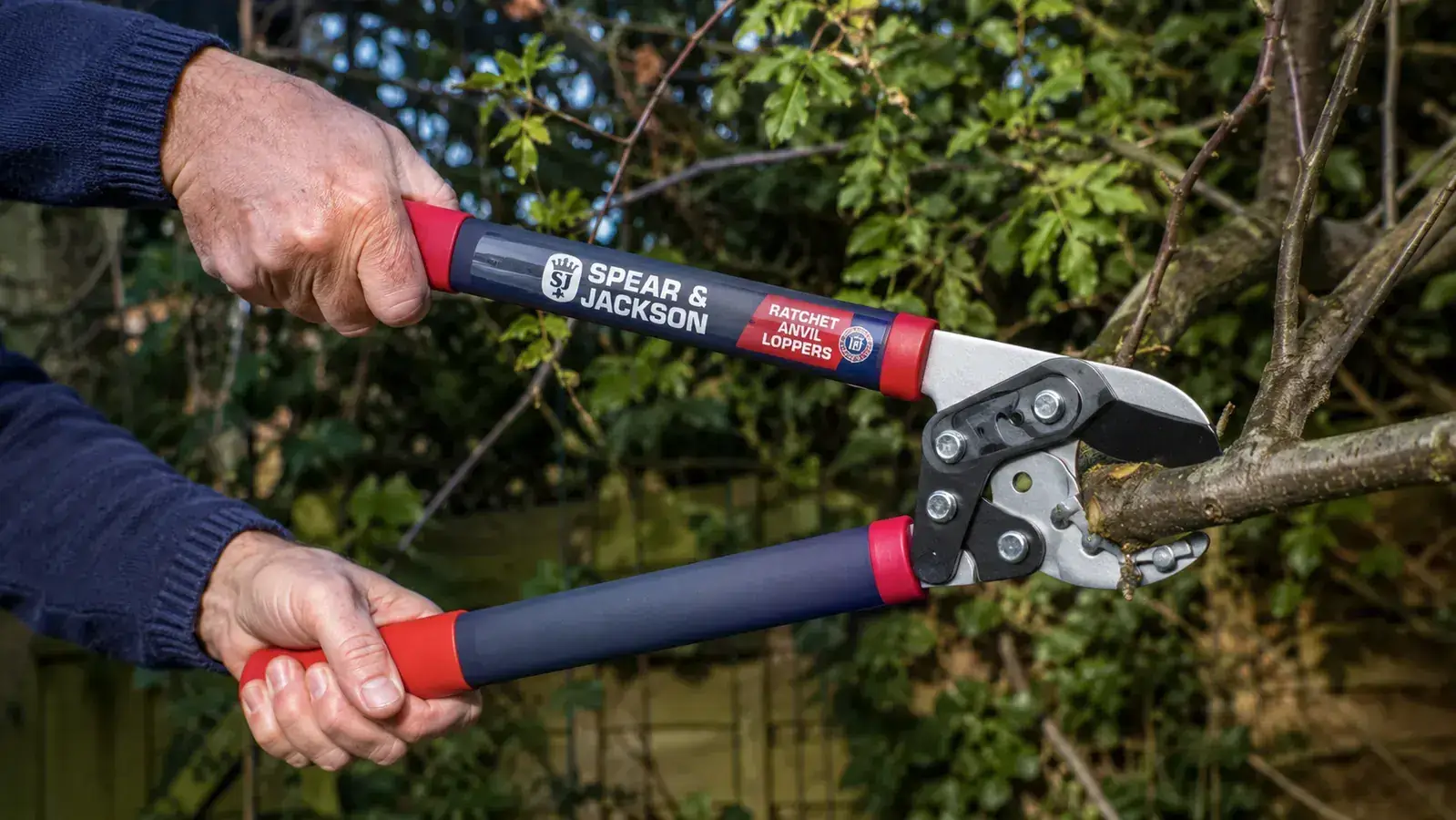
The ratchet mechanism is the main event. On a thick, woody branch, you don't have to make the cut in one hard squeeze. You bite down partway, release pressure, and the ratchet holds your progress while you reposition your grip and squeeze again. Three stages, and the branch is through. If your hands cramp up partway through a cut, or your wrist flexors just don't have the same endurance they did ten years ago, this is a meaningful thing. The Fiskars PowerGear's gear-and-cam system does multiply force, but it still asks for one continuous squeeze. That's the difference.
The telescoping handles are also a bigger deal than they look on the page. Going from 30 inches up to 40.5 inches means you're reaching overhead branches and thick hedge growth without lifting your arms to an uncomfortable angle. That extra reach changes your body position: you stand more upright, which takes pressure off your lower back. Frank's Fiskars are fixed at 32 inches, and he was visibly stretching to get the same cuts I made standing straight. On days when my back is talking, the extra 8 inches of reach costs me nothing.
Three stages and the branch is through. If your hands cramp up partway through a cut, the ratchet holds your progress while you reposition your grip.
The non-stick blade coating on the Spear & Jackson also does quiet work. When you're cutting through green, sappy growth, the blade glides rather than sticking partway through. It's a small thing on the first cut, but after fifty cuts it means you're not wiping sap off a sticky blade every ten minutes. And the cushioned rubber grips are genuinely padded compared to the hard plastic end caps on the Fiskars. An hour into hedge work, that padding matters.
Where the Fiskars PowerGear Wins
If you are cutting live green wood rather than old, thick, hard-to-compress growth, the Fiskars bypass blade makes a cleaner cut. Bypass blades work like scissors, and they leave a smaller wound on the branch. That's not trivial if you're pruning ornamentals or roses where clean cuts reduce disease entry. The Spear & Jackson is an anvil design, which means the blade closes onto a flat bar. That crushes the fiber slightly rather than slicing it clean. For most yard work, you won't notice the difference. For roses and ornamentals, a bypass blade is the right tool.
The Fiskars is also about three ounces lighter. That sounds like almost nothing, but if you're working for two hours overhead and fatigue sets in, a lighter tool is a lighter tool. Frank is in his early seventies and he said the Fiskars felt less tiring to hold aloft for extended sessions. The tradeoff is that lighter weight often means you feel more vibration feedback from each cut, especially on hardwood. The Spear & Jackson's heavier build absorbs some of that.
The Spear & Jackson works hardwood, hedges, and crape myrtles without wrecking your grip.
If you're cutting anything thicker than three-quarters of an inch or dealing with older wood that doesn't compress cleanly, the ratchet mechanism is the right tool. This is the one I'd buy again.
Amazon Check Today's Price on Amazon →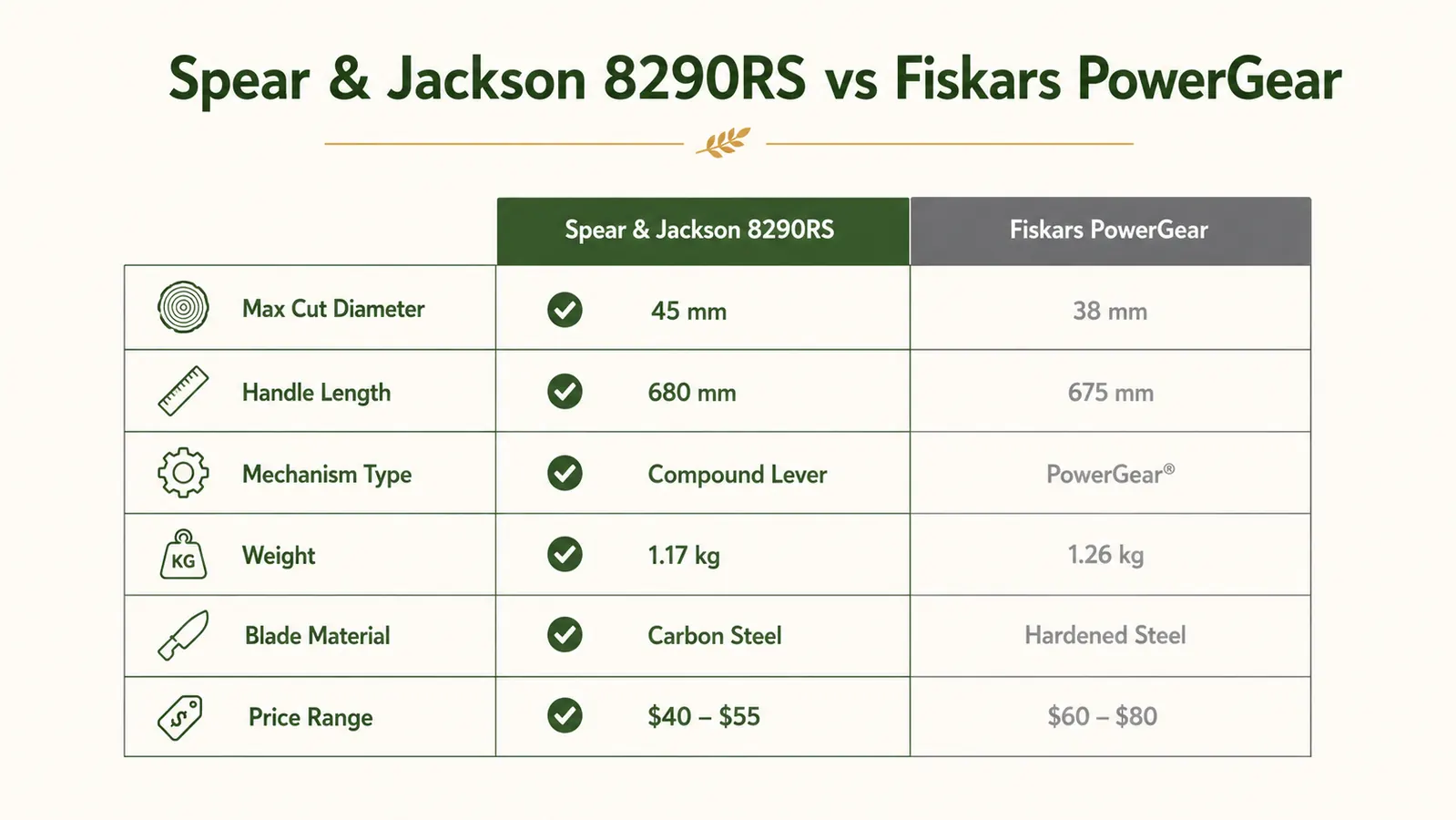
The Cut-Type Question: Ratchet Anvil vs PowerGear Bypass
The real decision comes down to what you're cutting most often. The Fiskars PowerGear is a bypass lopper that uses a gear-and-cam lever to multiply the force of your squeeze. It works well on green, live growth up to about 1.75 inches. It is not a ratchet. If the branch is too thick or too dry for one continuous squeeze to get through, you're in trouble. You either force it, which strains the gear mechanism over time, or you give up and go for the saw.
The Spear & Jackson is an anvil ratchet. The ratchet staging means you can work through 2-inch hardwood without one brutal squeeze, which is why it's the better tool for old crape myrtles, overgrown lilacs, and anything that's gotten away from you over a couple seasons. The anvil design is also more forgiving on the mechanism under heavy use. After a year and a half of hard work in my yard, the ratchet on mine clicks through its stages cleanly. No slipping, no grinding. That's worth noting.
For most backyard tasks, thick old growth is the harder problem. Green canes and small-diameter live wood you can cut with basic bypass hand pruners. You reach for loppers precisely when the wood is thick, old, or both. That's where the Spear & Jackson's ratchet mechanism earns its price.
Durability After Real Use
I've put the Spear & Jackson through two full seasons: one fall cutting back a row of crape myrtles that had been ignored for three years, and one spring clearing out a privet hedge that had gotten seriously out of hand. The blades have held their edge well enough that I haven't had to sharpen them yet, and the telescoping mechanism still extends and locks without looseness. The ratchet head, which is the part most likely to give trouble, hasn't skipped or seized. For a tool in this price range, that's a good track record.
I can't speak to multi-year Fiskars PowerGear durability from my own use, but from Frank's experience and the customer reviews, the gear mechanism on the PowerGear is more prone to loosening over time than a simple ratchet. Gears have tighter tolerances than a ratchet pawl, and they can develop play with hard use. That's worth knowing before you commit.
Who Should Buy Which
Buy the Spear & Jackson 8290RS if: you're cutting old, thick, or very woody growth; your grip strength or hand endurance is not what it was; you want telescoping reach for overhead work without straining your back; or you simply want a tool you can beat on for years without worrying about gear wear. It is the right lopper for the lion's share of backyard pruning work, and it's the one I'd recommend to a neighbor without hesitation.
Buy the Fiskars PowerGear if: you're primarily cutting live, green growth on roses, ornamentals, or shrubs where a clean bypass cut matters; you want the lightest possible tool for extended overhead sessions; or you genuinely prefer a bypass blade for its plant-health benefits on sensitive shrubs. It's a solid lopper, just not the stronger pick for the majority of backyard scenarios.
If you're on the fence, I'd tell you the same thing I told Frank: the ratchet is the harder problem to replicate. The PowerGear cuts well on green wood, but so does a standard bypass lopper. The ratchet mechanism is what lets a 65-year-old with arthritic hands get through 2-inch hardwood without wincing. That's the thing worth paying for. You can read more about my two full seasons with the Spear & Jackson in my long-term loppers review, and if you want the full honest picture, including the quirks, the honest review covers those too.
The Spear & Jackson ratchet loppers are the call if thick branches and tired hands are your reality.
Two seasons in, mine still click through their stages cleanly. For anyone dealing with reduced grip strength or old woody growth, this is the lopper that earns its place in the shed.
Amazon Check Today's Price on Amazon →